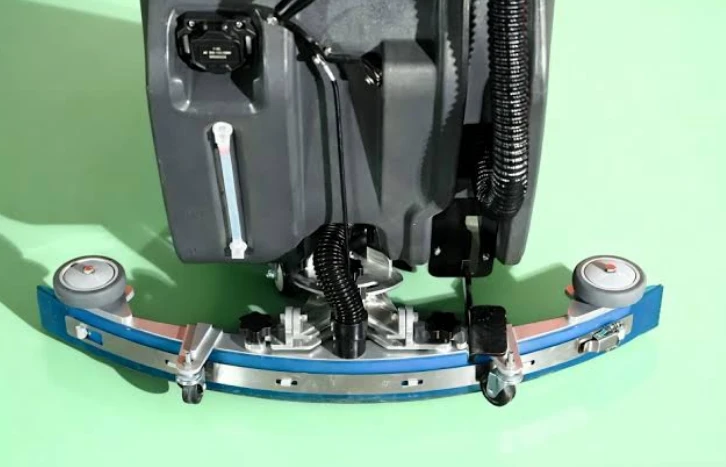
For a 5,000 m² facility, the recommended floor cleaning machine usually falls within the range of a commercial ride-on scrubber or high-capacity walk-behind scrubber. A machine with an effective cleaning rate of 3,000–5,000 m²/h, an 800–1,300 mm cleaning path, and 3–5 hours of battery runtime can normally complete daily cleaning within 1–2 hours. Selecting equipment based on floor type, traffic level, and operating schedule helps reduce unnecessary labor time and maintenance costs.
A 5,000 m² building requires a clear calculation of cleaning productivity before purchasing equipment. Manufacturers usually list theoretical productivity, calculated from brush width and travel speed, but actual performance is lower because operators need time for turning, stopping, refilling water, and avoiding obstacles.
For example, a scrubber with a 1-meter cleaning width moving at 5 km/h has a theoretical coverage rate of about 5,000 m²/h. In real conditions, efficiency is often around 55%–75%, giving an actual output of approximately 2,750–3,750 m²/h.
A machine rated at 5,000 m²/h may need 90 minutes to clean a 5,000 m² facility after accounting for normal operating interruptions.
The facility layout directly affects machine size selection. Large open spaces such as warehouses, distribution centers, and sports facilities usually benefit from ride-on machines because operators can maintain higher speed over longer distances.
A compact ride-on scrubber with a 700–900 mm cleaning width is often suitable for medium commercial buildings, while larger industrial machines with 1,000–1,300 mm cleaning widths are commonly selected for areas above 4,000 m².
| Facility type | Recommended machine width | Practical cleaning speed | Suitable area |
|---|---|---|---|
| Office buildings with rooms and corridors | 500–700 mm | 1,500–3,000 m²/h | 1,000–3,000 m² |
| Retail stores and schools | 700–900 mm | 2,500–4,500 m²/h | 3,000–5,000 m² |
| Warehouses and factories | 1,000–1,300 mm | 4,000–7,000 m²/h | 5,000 m²+ |
The machine category affects both cleaning time and labor requirements. Walk-behind scrubbers provide better control in narrow spaces, but the operator must continuously push and guide the unit. Ride-on models allow longer operation periods with less physical effort and are often preferred when cleaning areas exceed 4,000 m².
A facility cleaned manually or with small equipment may require 3–5 labor hours per cycle. A properly sized ride-on scrubber can reduce this period by approximately 40%–60%, especially in open areas with fewer obstacles.
The floor surface also changes the required machine specification. Smooth polished concrete generally needs less brush pressure than textured concrete, industrial flooring, or surfaces exposed to oil and heavy dirt.
For high-traffic facilities, brush pressure, water recovery performance, and cleaning chemical control become more important. A machine that only moves quickly but leaves water behind may require additional drying time and create safety concerns.
Floor condition should be evaluated together with machine size because a wider cleaning path does not always provide better results on heavily contaminated surfaces.
Battery capacity is another measurement when choosing floor cleaning equipment for a 5,000 m² site. Electric scrubbers commonly use lead-acid or lithium-ion batteries, with operating times ranging from 2 to 6 hours depending on machine size and cleaning settings.
Lithium-ion systems introduced in many commercial machines after 2015 have improved charging speed and battery cycle life. Compared with traditional lead-acid batteries, lithium-ion models may reduce charging downtime by approximately 30%–50%.
A typical 5,000 m² facility operating five days per week may require a machine capable of completing one full cleaning cycle without battery replacement. A battery capacity that supports at least 3 hours of continuous operation usually provides sufficient flexibility for most commercial applications.
Water capacity should also match the facility area. Cleaning machines normally use solution tanks and recovery tanks to manage water usage. A machine with a 100–150 liter solution tank can often cover several thousand square meters before requiring a refill.
Assuming water consumption of 0.05–0.1 liters per square meter, cleaning 5,000 m² may require approximately 250–500 liters of solution depending on dirt level, brush settings, and cleaning frequency.
The selection of professional floor cleaning equipment should consider operating costs over several years rather than only the initial purchase price. A machine with higher productivity may reduce labor expenses even if the purchase cost is higher.
For example, if a facility saves 1.5 labor hours per cleaning cycle and operates 300 days per year, the annual time reduction can exceed 450 working hours. In many commercial environments, labor represents more than 60% of total cleaning expenses.
Maintenance planning also influences equipment selection. Larger machines usually require regular inspection of brushes, squeegee blades, batteries, vacuum motors, and drive systems.
Most manufacturers recommend checking wear parts every 250–500 operating hours. Brush replacement intervals vary by floor material and usage intensity, with some commercial brushes lasting approximately 500 hours under normal conditions.
A machine that matches the facility size usually requires fewer operating cycles, which can reduce wear on motors, brushes, and water systems.
Cleaning frequency should be included in the sizing process. A facility cleaned once per week may need a different machine compared with a building cleaned every day. Daily cleaning schedules usually require equipment with stronger reliability and longer battery endurance.
For a 5,000 m² facility operating seven days per week, a ride-on scrubber with a cleaning width above 900 mm is generally more practical. For facilities with multiple separated areas, a smaller machine may provide better access even if cleaning time increases.
Noise levels, storage space, and operator training are also important factors. Many commercial facilities require machines below certain noise limits, especially hospitals, schools, and office buildings. Modern electric scrubbers often operate around 65–75 dB, allowing daytime cleaning in occupied areas.
Training time is another consideration. Operators typically need several hours of instruction to understand water flow adjustment, brush pressure settings, battery charging procedures, and daily maintenance checks.
A suitable configuration for a typical 5,000 m² commercial facility may include:
| Specification | Recommended range |
|---|---|
| Machine type | Ride-on scrubber or large walk-behind scrubber |
| Cleaning width | 800–1,300 mm |
| Productivity | 3,000–5,000 m²/h |
| Solution tank | 100–150 L |
| Battery runtime | 3–5 hours |
| Daily cleaning time | 1–2 hours |
Choosing the correct machine size requires matching equipment capacity with actual cleaning conditions. A 5,000 m² facility does not always require the largest available machine; it requires equipment that can complete the cleaning schedule efficiently while maintaining consistent floor quality.