A factory-direct procurement plan should make it clear who is selling and manufacturing the goods, what exact product is being ordered, how quality and changes are controlled, where money and responsibilities flow, and what must happen before shipment release. Reviewing those points before production helps buyers identify gaps that could otherwise appear as a payment dispute, wrong product, late cargo, or missing documentation.
Key takeaways
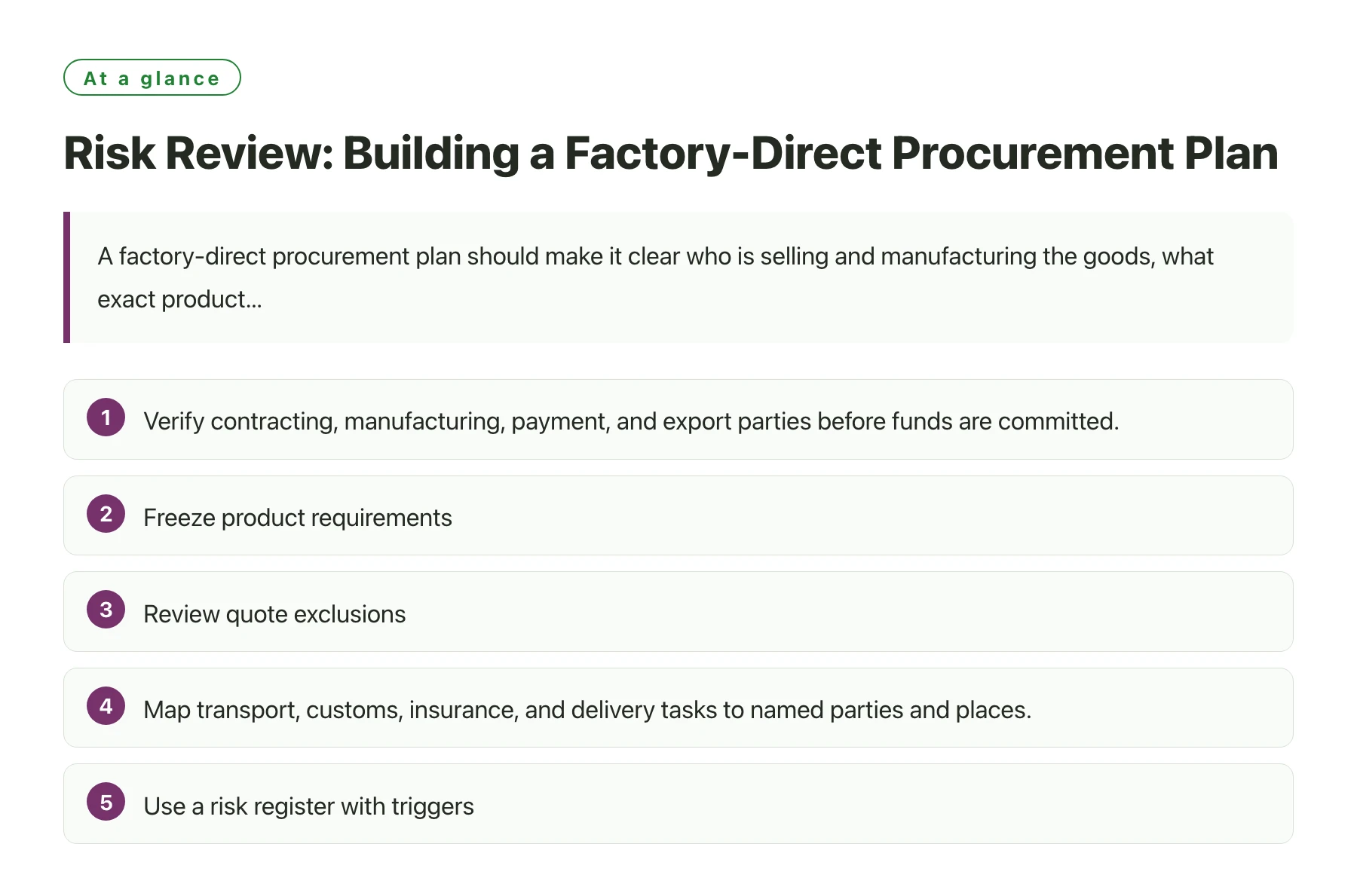
- Verify contracting, manufacturing, payment, and export parties before funds are committed.
- Freeze product requirements, sample approval, inspection criteria, and change authority in writing.
- Review quote exclusions, payment milestones, tooling ownership, and supplier remedies.
- Map transport, customs, insurance, and delivery tasks to named parties and places.
- Use a risk register with triggers, response owners, and shipment hold or release rules.
Assess risk as a set of specific failure paths with controls and owners, not as a general impression of a supplier.
Identify the parties and commercial path
Write down the legal seller, factory, production site, payment recipient, export party, and any intermediary. These may be separate entities. Confirm which party signs the purchase contract and who is accountable for specification compliance, schedule, warranty, corrective action, and export documents. An unclear party structure can delay a decision when goods or payments do not match expectations.
Verify business and banking information through appropriate records and established contacts. If bank instructions change, use a known independent channel to confirm the change. Ask what role a trading company or sourcing service performs and how its fee or compensation is disclosed. Make sure supplier introductions do not obscure who owns the contractual relationship or product decisions.
Buyers may JS Sourcing to coordinate work, but the procurement plan should assign decision rights regardless of who supports it. Name who selects suppliers, approves samples, accepts deviations, authorizes spend, and releases goods.
Review specification and change risks
Check that the quote and purchase order refer to the same model, drawing revision, materials, dimensions, components, finish, packaging, labels, quantity, and destination. List requirements that are mandatory and assumptions that remain open. The factory should know which file is current and how obsolete copies are removed from production.
Identify changes that require written approval: material substitution, component supplier, manufacturing site, process, tooling, label, package, quantity, or test evidence. Define who assesses technical impact, cost, lead time, compliance, and warranty implications. A supplier should not treat an unavailable part or schedule pressure as automatic permission to substitute.
For each critical feature, ask how production and inspection will verify it. If a claim cannot be checked by ordinary visual inspection, identify the needed test, record, or specialist review. Make the scope and limits explicit so a report does not imply checks that were never performed.
Assess supplier capability and continuity
Verify that the factory has processes, equipment, personnel, and sourcing arrangements for the requested product. Ask which work is subcontracted and how changes to those parties are approved. Consider how the supplier would respond if a key component becomes unavailable, production capacity shifts, or a facility is disrupted. Continuity plans should be concrete enough to identify alternate options and their approval requirements.
Check capacity against the order quantity and dates. Ask when materials are committed, how the order is scheduled, and what triggers a delay notification. If production depends on buyer approval or imported components, include those dependencies in the calendar. Consider whether a single factory or component source creates an exposure that matters to the project.
Review relevant quality records and prior product evidence without overreading broad certificates. A management system or facility audit can inform a defined review, but it does not by itself prove the current product or lot meets the purchase specification. Keep evidence connected to model, site, scope, date, and decision.
Protect payment and asset interests
Map deposits, progress payments, final balance, sample costs, tooling, molds, and any third-party expenses to documented milestones. Clarify who owns custom tooling, where it is stored, how access is granted, what happens on contract termination, and whether maintenance or transfer costs apply. Obtain finance or legal review of substantial advance payments and remedies.
Set evidence requirements before each payment: approved sample, tooling inspection, material confirmation, progress photos, inspection report, shipment documents, or another agreed record. Payment triggers should be observable and tied to the named order. If a payment depends on production completion, define how that completion is verified.
Clarify refund, delay, defect, replacement, and cancellation terms. Identify how claims are raised, what deadlines apply, and who bears costs for rework, replacement, or return freight. Keep purchase orders, invoices, acknowledgments, and payment receipts together so reconciliation is possible if parties or amounts differ.
Set quality and release controls
Create an inspection plan with product identity, lot definition, timing, tests, sample method, acceptance criteria, defect categories, reporting format, and buyer authority. Decide when a visit is useful and what evidence it can provide. A sample-based check does not observe every item, and a visual inspection cannot answer every technical question. Route specialized characteristics to the appropriate tester or reviewer.
Define containment for defects or missing evidence. The factory may need to segregate affected units, repair, replace, or propose a concession. Set who can accept a concession and when a re-inspection is required. Do not permit shipment because a deadline is approaching if a required safety, contract, or compliance decision remains open.
Name the release owner and the records needed before dispatch: final inspection disposition, approved specification, change log, quantity, package and label checks, required product records, invoice, packing list, and booking. Keep a written hold instruction visible to the factory and logistics provider while any condition remains unresolved.
Check shipment responsibilities and risk transfer
Write down pickup location, named destination, delivery term and edition, transport mode, insurance, customs responsibilities, unloading, and final-mile delivery. The U.S. International Trade Administration explains that Incoterms allocate specific tasks, costs, and risks between buyer and seller. [1] Use the selected rule with a precise place in the contract and ask a logistics professional to confirm the intended handoffs.
Check what the supplier’s price does not include: inland haulage, export handling, port charges, freight, insurance, duties, customs brokerage, storage, destination handling, or delivery appointments. Ask for quote assumptions based on actual package dimensions and weights. Identify who responds if a shipment is delayed, damaged, held, or routed to the wrong destination.
Confirm cargo readiness, packing, marks, documents, and booking dates. If split shipment is permitted, define how partial quantities are identified and whether additional freight or customs costs apply. Ensure contract terms, invoice, and booking instructions do not conflict about who pays or arranges each activity.
Prepare a practical risk register
For each material risk, record the event, cause, effect, likelihood or priority, preventive control, evidence, response owner, trigger, and fallback. Examples might include an unapproved substitution, incomplete documentation, sample mismatch, late component, damaged packaging, or missed booking. Use the project team’s risk scale rather than assigning artificial precision to uncertain judgments.
Set escalation thresholds. Specify which issues stop production, hold payment, prevent inspection closure, or block shipment. Name backup contacts for buyer, supplier, quality, finance, and forwarder. A risk register is only useful if someone reviews it at milestones and updates it when specifications, dates, or parties change.
Test the plan with a few realistic scenarios. Ask what happens if the factory misses a sample date, a test result is delayed, an inspection finds a defect, or a bank detail changes. Confirm who acts, which records are checked, and whether the response protects product, money, and schedule.
Monitor performance through delivery and receipt
Track quote assumptions, production milestones, inspection findings, shipment status, actual costs, and receipt condition against the original plan. Record forecast changes promptly and distinguish supplier, buyer, carrier, customs, and external causes. This helps the buyer identify which control worked and where a dependency was missed.
At receiving, compare quantity, model, lot, labels, package condition, and documents with the release record. Record shortages, damage, or mismatch before goods are mixed into inventory. Preserve relevant packaging and photographs if a claim may be needed. Use the contract’s notice process and involve the right technical owner.
After closure, review actual issues and control effectiveness. Update supplier qualification, inspection depth, payment evidence, delivery buffers, or contract language where the evidence supports a change. Keep lessons tied to the specific product and transaction rather than turning one order into an unsupported general judgment.
Sources
Frequently asked questions
What is the biggest risk in factory-direct purchasing?
There is no single risk for every order. Start with unclear seller or factory identity, vague product scope, uncontrolled changes, payment exposure, and unassigned delivery duties.
Should payment milestones be linked to records?
Yes. Define observable evidence for each agreed milestone, identify who reviews it, and connect the record to the purchase order and product configuration.
Do delivery terms allocate every cost and responsibility?
They allocate defined tasks, costs, and risks. Contract terms, customs requirements, service fees, and any uncovered activities still need separate review.
When should a shipment be held?
Hold the affected goods if an agreed release condition, required evidence, material deviation, or unresolved compliance decision could change whether the lot may ship.